We live in an era rapid modernization, in a world that is becoming smaller through the exchange of ideas and products. International public opinion has become an increasingly important driver of political change and decision-making over the course of the last few years. In that context, there has been considerable attention devoted to the global gender gap in attitudes – and particularly differences in opinions among men and women in predominantly Muslim countries.
In this paper, we use comparative international data to analyze a broad array of issues relating to the global gender gap: Are women “doves” and men “hawks” when it comes to foreign policy and security matters? Do men and women have different beliefs on religion and morality? Is it possible to identify regional patterns in gender differences? And specifically, what are the major fault lines in opinions among men and women in predominantly Muslim countries?
To find the answers to these and other questions, we used the Pew Global Attitudes Project, a series of worldwide public opinion surveys administered by local organizations under the direction of Princeton Survey Research Associates International. To date, the Project has interviewed over 74,000 people in 50 populations (49 countries and the Palestinian Authority).
A commentary released by the Project last October addressed some of the general questions about the way men and women view their lives and increasing global interconnectedness. Here are the primary conclusions (Some copies of the release are available at the conference or on the Pew Research Center’s website at people-press.org):
- On the whole, women are happier with their lives and say they’ve made personal progress more than men.
- Within regions, men and women agree on almost every issue addressed, from personal progress to social issues, such as the acceptability of homosexuality.
- Men are more optimistic about the lives of their children and the future than are women.
- When asked about modern electronics and technological advances that are so much a part of the globalizing world, both men and women agree that having these available is a change for the better. But in 37 of 44 countries, “boys” like their high-tech “toys” much more than women.
- Birth control is popular among both the sexes, but in two-thirds of the countries surveyed, women are more likely to think having the ability to control reproduction is a change for the better.
Most people around the world are dissatisfied with the way things are going in their country, but women are most dissatisfied. The difference is greatest in France where 39% of men and only 26% of women are satisfied with national conditions, and in the U.S., where 47% of men are satisfied but only 36% of women agree.This paper builds upon this initial analysis and looks specifically at the opinions of Muslim men and women on issues ranging from religion to social and political values. It also compares these views with those of men and women worldwide. It concludes with a look at how the sexes view current foreign policy issues and terrorism. Several primary conclusions can be drawn from this work:
- Few gender gaps exist among Muslims regarding the role of Islam in political life, and when gender differences do surface, it is within specific countries and not part of a broader pattern.
- Muslim men are more likely to favor more traditional roles for their female counterparts, while more women express a desire to bring gender equality into the workplace and into their marriages.
- Women, particularly in the Muslim world, decline to answer polling questions or say they don’t know at a much higher rate than men. Yet there is a pronounced pattern to their DK/Refusal response, suggesting that it is the type of question that determines whether or not women offer an opinion.
- When attitudes are measured only among those who respond to questions, men and women share similar opinions about the role of Islam in their society, women in the workplace and a host of political and personal issues.
- Suicide bombings and violent acts of killing are not just supported by men. As many women as men in several predominantly Muslim countries say such activities are justified.
- In the most recent survey taken in March 2004, men and women within their own countries in Muslim nations share common views on foreign policy issues and the war in Iraq, suggesting that national identity is more important than gender differences in these cases.
- Among Muslims, there is little difference between the genders on foreign policy issues, the war in Iraq and favorability of world leaders in the U.S. and Europe. However, women are somewhat less likely to express an opinion on these issues.
Muslim Surveys

In the 44-nation survey of the Pew Global Attitudes Project, 14 countries where Muslims are either the overwhelming majority or prominent minorities were asked a series of questions pertaining specifically to the role of Islam and governance. In smaller, subsequent surveys, additional populations were surveyed. Those populations noted as “predominantly Muslim” are Pakistan, Turkey, Jordan, Lebanon, Indonesia, Bangladesh, Mali, Senegal and Uzbekistan. Smaller surveys incorporated the Palestinian Authority, Morocco, and Kuwait. Muslims surveyed in countries where they are a minority of their country’s population are Ghana, Ivory Coast, Nigeria, Tanzania and Uganda. In three cases where there are Muslim minorities — Ivory Coast, Ghana and Uganda — gender breakouts are not reported due to small sample size.
Islam and Politics

Majorities in over half of the Muslim nations surveyed say Islam currently plays a large role in the governance of their society and just as many say it should play that role. Overall, men and women share the same views within their countries in nearly every nation surveyed. Only in Uzbekistan and Jordan are there significant gaps in opinion between the sexes. A 12-point gap exists in Uzbekistan with 48% of Uzbek men and 60% of women saying Islam currently plays a large role; in Jordan, more men than women say the role of Islam is significant (58% to 48%).
When asked of the role Islam should play in the governance of their countries, opinions correspond with the respondent’s beliefs in the role Islam currently plays. Majorities of Muslims in 9 of the original 14 nations surveyed said Islam should play a large role. In four others (Lebanon, Turkey, Senegal and Uzbekistan), respondents are split on this issue and only in Tanzania do Muslims say Islam should play a small role in the politics of their country. Again, men and women view the political role of their religion in roughly the same way.
In Nigeria, a country grappling with the issue of Sharia law, it may be surprising to find that women express a stronger belief that Islam should play a large role in the governance of their country. Although more than eight-in-ten respondents of both genders agree that Islam currently plays a large role, only 66% of Nigerian men say they think it should play a large role while 79% of women hold such views. Jordanian men and women hold differing opinions on many issues, the role of Islam being one. Men in Jordan say they want Islam to play a large role in politics much more than women and women are more likely to say that their religion currently plays less of a role in politics than men.
Democracy Can Work Here

Majorities of Muslims surveyed by Pew say that “Western style democracy” can work in their own country, with Indonesia a notable exception. Few Muslims say that democracy is “a Western way of doing things that would not work here.” The latter view is expressed by a majority of Indonesians (53%), and sizable minorities in Turkey and the Palestinian Authority both at 37%.
The belief that democracy can work in their country is shared fairly equally by both men and women. The exception is Bangladesh; 76% of Bangladeshi men and just 42% of Bangladeshi women say democracy can work here. Even after accounting for the higher non-response rate among women, Bangladeshi men believe more strongly than women in the democratic prospects for their countries.
However, the most significant change in the idea of “Western-style democracy” from 2002 to 2003 is the number of women who express an opinion. Perhaps because of the Iraq war and the increased international discussion of regime change in the Middle East, only a quarter of the women in Pakistan did not offer an opinion in 2003, whereas 57% did not do so in 2002. Less dramatically, yet still significantly, the number of men who did not respond decreased 17 points, from 21% in 2002 to 4% in 2003.
Interestingly, since 2002, Turkish respondents (both men and women) have increased their belief that Western-style democracy can work there. While 43% of men and 44% of women held such views in 2002, fully 51% of men and 49% of women said democracy could work in Turkey in 2003.
Democratic Aspirations
In addition to large numbers of both genders saying that democracy could work in their country, many Muslim men and women register high levels of support for the key democratic principles. Majorities in six countries, (Turkey, Mali, Bangladesh, Senegal, Nigeria and Lebanon) say it is very important to be able to live in a country where you can openly say what you think and criticize the government, have freedom of the press, and open and honest elections. Men and women within those countries have nearly identical views about these key freedoms yet women tend to give an opinion much less often than men. This is particularly the case in Pakistan, Bangladesh, and Turkey and to a lesser degree elsewhere. Women who do register an opinion place equal importance on these democratic aspirations.
The DK/Refusal Effect
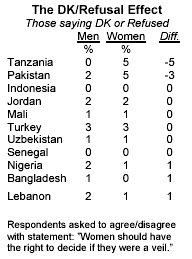
The discrepancy in the way men and women register opinions on various issues mentioned above shows that women, particularly in Muslim countries, respond “don’t know” or “refused” to questions with much more regularity than men. But, interestingly, the kind of question makes a big difference. Two spheres exist, the personal, home sphere dealing directly with women’s roles and personal lives, and a worldly sphere relating to opinions about the government, international problems, and political views. When asked about government policy or whether or not democracy can work in their country, fully 60% of women in Pakistan, (21% of men) 42% of Bangladeshi women (18% of men) and 18% of Turkish women (10% of men) do not register a response. The same is true when asked about the role of Islam in politics. Pakistani men register opinions at a much higher rate than women.

Yet, when asked about personal issues that deal directly with them, women are much more likely to offer a response. For example, when asked to agree or disagree with the statement, “women should have the right to decide if they wear a veil,” only 5% of Pakistani women did not respond, all Bangladeshi women gave a response and only 3% of Turkish women (equal their male counterparts) failed to respond. The dk/refusal rates are nearly identical when asked a series of questions about women’s role in the workplace and religious education.
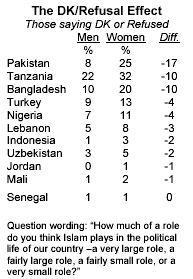
After accounting for this difference by repercentaging the results between men and women, the findings are striking— the gender gap shrinks to near irrelevance. For example, 68% of Pakistani men said religious leaders should play a larger role in politics, whereas only 57% of women held that view. After accounting for the dk/refusal effect by basing the total on those who registered a response, the percentage of women believing religious leaders should play a larger role in politics was actually greater than men. Fully 84% of women and 74% of men who responded took that view.
The Role of Women in the Workplace
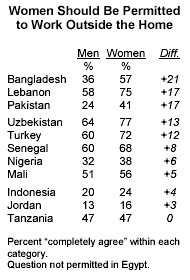
Women may not register opinions at a fairly high rate when asked about politics or government, but it is clear that they willingly share them regarding their roles in the social structure of their country and their personal values. This is especially true when Muslim men and women are asked about women’s roles in society.
In many countries, there is a significant gender gap among Muslims over whether women should be permitted to work outside the home. In Bangladesh, 57% of women completely agree that they should be allowed to work, compared with 36% of men. The gap is nearly as wide in Pakistan, where 41% of women strongly agree with that statement, compared with roughly a quarter of men (24%). Even in countries where Muslims broadly support women’s right to work outside the home, such as Lebanon and Turkey, differences between men and women are sizable.

Indonesia and Jordan are notable exceptions to this pattern. In those countries, support for women working is equally weak among members of both sexes. Just 24% of Muslim women in Indonesia, and 20% of men, strongly agree that women should work outside the home, and support is even lower in Jordan (16% to 13% respectively).
There is less of a gender gap over restrictions against men and women being employed in the same workplace. In most cases, women are as supportive of these restrictions as are men. While women in Bangladesh are much more likely than men to strongly favor the right of women to hold jobs, they also are more supportive of separating men and women in the workplace. More than a third of Muslim women in Bangladesh (36%) completely agree that such restrictions are appropriate, compared with 20% of Muslim men.
Type of Marriage
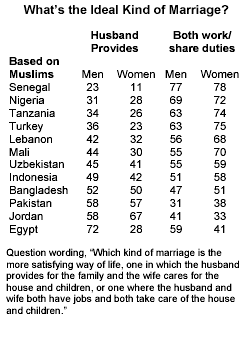
Questions on the role of women in the workplace were not only asked of Muslims. In the Global Attitudes Project inaugural survey in 2002, publics around the world were asked to identify the type of marriage that was most appealing to them. Majorities throughout Europe, the Americas, Asia and Africa expressed the desire for both spouses to have jobs and share in household and child care duties. A majority of Americans agree, but to a lesser degree than many Africans and Turks, with 58% of the total U.S. population surveyed supporting both spouses working and 37% disagreeing. There is a large difference of opinion among predominantly Muslim countries, such as Egypt, Pakistan and Jordan, which are the sole countries to favor the more traditional role of women, where the man provides the income and the woman takes care of the household and children.
Homosexuality, Religion and Morality
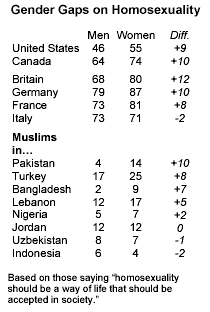
The Global Attitudes Project reported a gaping transatlantic divide on social issues from the acceptability of homosexuality to social welfare between the U.S. and Europe. While the two regions are divided, another transatlantic gender gap also exists. Women in the U.S. are more accepting of homosexuality than American men, as are nearly all western European women.
Even among Muslims in regions as diverse as Pakistan, Turkey, Bangladesh and Lebanon, women express views of acceptance for homosexuality more than their male counterparts. The outlaying exceptions are Italy where both genders register almost equally large endorsements for homosexual acceptability (73% of men and 71% of women), and among Muslims in Uzbekistan, Indonesia and Jordan where an equally insignificant difference between the genders opposes homosexuality.
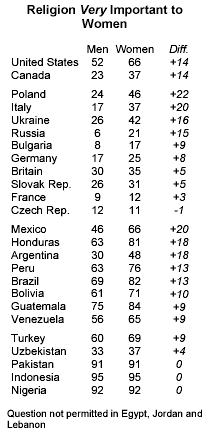
Women around the world say religion is more important to them than men in every region, in highly religious countries such as those in Latin America and in more secular societies such as Canada and Europe. Only in Muslim countries such as Pakistan and Indonesia, where nearly everyone expressed the importance of religion in their lives, were there few gaps between genders. On the question of whether or not you have to believe in God to be a moral person, women in 34 of 39 countries (question not permitted in China, Vietnam, Lebanon, Jordan and Egypt) say that belief in God is tantamount to personal morality. Where men hold this opinion more than women, it is only by a slim margin—for example in France 16% of men and 10% of women hold this opinion and in Nigeria the margin is 86% to 84% respectively.
With women expressing greater importance of religion in their lives, how do Muslim women feel about religious education for their children? The Muslim world is divided over whether schools should focus more on practical’ subjects and less on religious education. Half of the countries surveyed, including Turkey and Uzbekistan, support putting greater emphasis on practical education and several other countries, notably Indonesia, Pakistan and Jordan strongly oppose this idea. Yet despite the difference in male and female attitudes toward religion in Muslim societies, there is no large gap between the genders on religious education. The greatest difference is found in Nigeria where 26% of men completely agree that practical education should be given precedent with only 18% of women saying the same thing. Elsewhere, in Turkey, Pakistan and Uzbekistan, men and women mirror each other’s response.
Muslim men and women are also in agreement within their own countries on whether their religion should tolerate diverse interpretations of Islam’s teachings or if there is only one true interpretation of those teachings. The only significant gender gap is in Pakistan where 39% of women who offered a response favor diversity with 27% of men agreeing.
Threats to Islam

The perception that there are serious threats to Islam is widespread and growing in the Muslim world. This is most pronounced in Middle Eastern countries such as Jordan, Lebanon, Morocco and the Palestinian Authority, where over two thirds of respondents in each country see Islam threatened. But this view is not limited to that region alone. Since the war in Iraq, over half of Indonesians (59%), Pakistanis (64%) and half of Turks feel major threats to their religion. These proportions are all up considerably since the Pew survey began polling in 2002, before the war in Iraq. Even in Nigeria, respondents saying Islam is seriously threatened have doubled since 2002, from 21% to 42%.
Men in most places feel threat more intensely than women, with the exception of Uzbekistan where women site serious threats to Islam by 4 percentage points over men. The biggest gender gap in opinion exists in Senegal where 71% of men see Islam threatened, but only 45% of women and Bangladesh (59% and 33% respectively). But the largest shift in opinion from 2002 to 2003 was in Pakistan. In the span of one year, men seeing a threat jumped 17 percentage points while women perceiving threats to Islam skyrocketed from 19% to 70%.
But what are these serious threats? Polling in 2002, prior to the US-led war in Iraq, found that people were not primarily worried about external, political, military or cultural threats. Instead most cited internal threats within their own country, such as government interference with religion, a diminishing commitment to Muslim teachings and schools among the young, or a lack of Islamic unity and moral decline.
Men and women express very different views of threats to Islam. Men list “terrorism” more often than women and also say that the U.S. and the West pose larger threats to Islam than their female counterparts. This is particularly prominent in Bangladesh and Pakistan. Women see local government and politics as larger threats to their religion, especially in Indonesia and Turkey. Women around the Muslim world agree that internal religious issues and the direction of Muslim education within their countries pose large problems for Islam. This is particularly distinct in Turkey where twice as many women than men say religious issues within Islam are the main threat to their faith.
Lebanon and Jordan are exceptional in that both sexes cite external threats to Islam more often than internal threats, a departure from any other country surveyed. There, terrorism and U.S./Western threats and even the influence of other religions far outweigh any internal threats to their religion. In addition, men and women share in this opinion equally, with nearly identical emphasis placed on those threats outside their country.
Similarly, the genders in Uzbekistan have few discrepancies in their responses on this issue, each saying that people within their own country (specifically Vakhabists, or religious fundamentalists) posed the largest threat to their religion. The threat of terrorism was also of primary concern to Uzbek men and women and they agreed to equal degree that the problem threatened their religion.
In sum, women in the Muslim world are more focused on internal threats to Islam, whereas men are more threatened by the other religions and the U.S./Western war on terrorism.
Suicide bombings
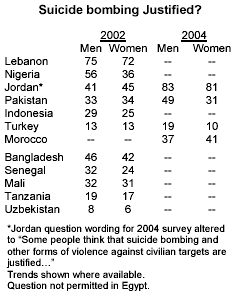
In the 14 Muslim countries surveyed in the inaugural 2002 poll, men were more likely to say suicide bombings and other forms of violence against civilian targets is justifiable than women. However, the gaps between the sexes are not large, with two contrasting exceptions. In Nigeria, a majority of men say suicide bombing is justifiable (56%) and only 36% of women say so. But 4,500 miles to the east in Pakistan, a majority of women who gave a response say such violence is justifiable much more than men. The re-percentaged ratio shows that 55% of women compared with 37% of men believed suicide bombing could be justified.
In an era where women are themselves joining the ranks of suicide bombers in the Middle East, it may come as little surprise that nearly three quarters (72%) of Lebanese women agree with their male counterparts that such actions are justifiable. In Jordan, the number of women sharing that view slightly outnumbers men, 45% to 41%.
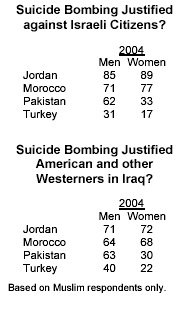
Two additional questions regarding suicide bombing were asked in 2004 using specific scenarios. One asked about the justifiability of suicide bombing carried out by Palestinians against Israeli citizens and the other asked about such acts carried out against American and other Westerners in Iraq. When presented with these two cases, the number of people in all four countries saying that violence is justified, increased, and, in Turkey, increased considerably.
But the most astonishing figures come from Muslim women in Jordan and Morocco. There, more women than men say suicide bombings against Israeli citizens are justified, with fully 89% of Jordanian women and 77% of Moroccan women saying so compared with 85% and 71% of their male counterparts respectively. In Pakistan and Turkey, more Muslim men than women say such acts of violence are justified, yet still 33% of Pakistani women say so compared with 31% of Turkish men and 17% of Turkish women.
The same pattern holds when asked about suicide bombing of Americans and other westerners in Iraq. Again, Jordanian and Moroccan women believe these acts are justifiable by a slight margin over men in their country, whereas it is the men in Pakistan and Turkey who say this.
Foreign Policy and the War in Iraq
This paper has focused primarily on Muslim views but it is worth noting that men and women within their countries have very similar views of foreign policy issues. A nine country survey March 2004 examined the war in Iraq one year after it began and revisited some of the same questions about the America’s image in the world and U.S.-European relations that the inaugural survey examined. A few key points are worth mentioning. Overall, there is little difference in the views of men and women on most foreign policy questions, issues dealing with the Iraq war and use of force within their own countries. In addition, no clear regional patterns emerge.
One interesting finding from the new survey supports Pew’s original analysis– that men in all countries except Britain express more optimism about their lives and those of their children. In 2004 men believe people from their country who move to the United States have a better life more than women. This is especially true in Jordan where 38% of men believe immigrants to America are better off, but only 25% of women agree. In Britain women are only slightly more hopeful of the lives of British immigrants with 43% believing them better off and men just behind at 40%.
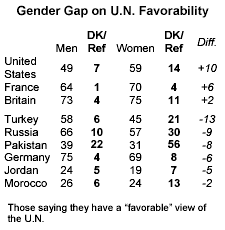
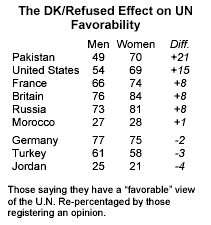
What is apparent is that the DK/Refusal effect both widens and narrows the gender gap with regard to foreign policy questions. As noted previously, women in all parts of the world are less likely to give an opinion on political issues than men, but taking that into account only muddies the picture and highlights the importance of intra-country differences.
After accounting for the higher rats of opinion giving, Pakistani men and women tend to fall further apart on most questions, yet in most other nations, the gap narrows. Three examples exemplify this finding: When asked to rate the United Nations, men in six of nine countries surveyed have a more favorable view of the world institution than women. Yet, due to the DK/Refused effect, women in six of nine countries rate the U.N better than men and the gap is narrowed in all of the remaining three. Smaller differences in view on foreign policy questions such as the relationship between the U.S. and Western Europe and pre-emption, show the same pattern, where, after accounting for opinion registry women and men the gender gaps narrow.
Conclusion
This analysis fails to detect any systematic difference between the genders when it comes to issues of governance, foreign policy and current international conflicts. Only on specific domestic issues of particular immediacy to men and women do the genders differ in their views. The data suggest the historic gender gap has diminished and one’s sex does not appear to predict opinion on a variety of issues the way it once did. The findings outlined here are only a first step, not the definitive work measuring opinion differences. Future in-depth analysis of other important cleavages such as age and education will be crucial to our understanding of ways in which men and women voice their opinions and which issues gender differences will surface in the future. For in the end, we may find we are not so different after all.