by Richard Wike
The recent declaration of emergency rule by President Pervez Musharraf has once again drawn the world’s attention to Pakistan. As the following Pew Research Center article from August details, over the course of 2007 Musharraf’s popularity has steadily declined. Moreover, an International Republican Institute (IRI) poll conducted in September shows that since the original publication of this article, Musharraf’s approval rating has dropped even further — to 21%. The IRI poll, conducted before the state of emergency was declared, also found that 83% of Pakistanis opposed emergency rule.
As American leaders from George W. Bush to Barack Obama talk tough with Pakistani President Pervez Musharraf about getting tough with al Qaeda, Pakistanis may feel torn between sympathy and outrage. On one hand, they increasingly reject terrorist tactics and al Qaeda leader Osama bin Laden. But on the other, they continue to express both fear and loathing of the United States. Most Pakistanis fear the U.S. could become a military threat to their country, and despite their opposition to terrorism, few support the U.S.-led war on terror.
Support for Terror Drops
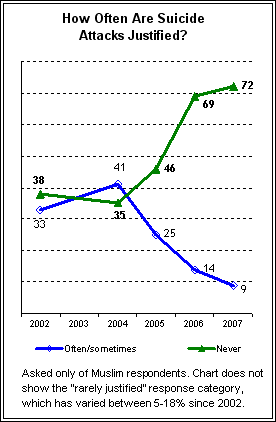
According to the recently released National Intelligence Estimate (NIE), Pakistan remains a safe haven and base of operations for al Qaeda. Nonetheless, public opinion in Pakistan has actually grown considerably less supportive of terrorism in recent years. In 2004, 41% of Pakistani Muslims said that suicide bombing and other forms of violence against civilians were “often” or “sometimes justified” in order to defend Islam from its enemies, while only 35% felt that such attacks were never justified.1 Today, only 9% say suicide attacks are often or sometimes justified, while 72% say this kind of violence is never defensible (another 9% say they are “rarely” justified).
Similarly, support for Osama bin Laden has waned. In 2005, 51% of Pakistanis said they had a lot or some confidence in bin Laden to do the right thing in world affairs. Now, confidence in the al Qaeda leader has fallen to 38% — still disturbingly high, but nonetheless a substantial decline in just two years.
Over the last few years, Pakistan has suffered a number of deadly terrorist attacks, including a series of suicide bombings in July, following a government raid on the Red Mosque, a militant Islamist stronghold in the capital city, Islamabad. More than three-in-four Pakistanis (76%) call terrorism a “very big problem” for the country. Among the 47 countries included in the 2007 Pew Global Attitudes survey, only Bangladeshis (77%) and Moroccans (81%) are more worried about terrorism. And in a 2006 Pew survey, 74% of Pakistanis said they were very or somewhat concerned about the rise of Islamic extremism in their country — a higher level of concern than found in the other predominantly Muslim countries included in the survey: Jordan (69%), Egypt (68%), Turkey (46%), and Indonesia (43%).
Negative Attitudes toward the U.S.
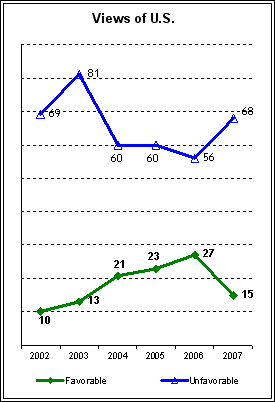
But rising resistance to terrorism has not translated into support for the United States or its war on terror. Fewer than one-in-five Pakistanis (15%) have a positive view of the U.S. — only Palestinians (13%) and Turks (9%) are less favorably disposed. Attitudes toward the U.S. have been consistently negative for years in Pakistan, although America’s unfavorable rating peaked in 2003, shortly after the launch of the Iraq war. And views actually grew a bit more positive in 2006, following U.S. aid to victims of Pakistan’s devastating October 2005 earthquake. This year, however, opinions of the U.S. have again grown more negative.
Moreover, despite their own concerns about terrorism, Pakistanis overwhelmingly oppose U.S.-led efforts to fight terrorism — six-in-ten (59%) oppose America’s anti-terror campaign, while only 13% back it. Like many other Muslim publics throughout Asia, the Middle East, and elsewhere, Pakistanis also oppose other key facets of American foreign policy. Three-quarters (76%) say the U.S. should remove its troops from Iraq, and a similar proportion (75%) believe the U.S. and NATO should withdraw from Afghanistan, which shares a 1,500 mile border with Pakistan.
But Pakistanis are not just worried about the use of American force in neighboring countries. They also fear they could become a target. More than seven-in-ten (72%) are very or somewhat worried that the U.S. could become a military threat to their country. And 64% name the U.S. as one of the countries posing the greatest potential threat to Pakistan, more than even longstanding arch-rival India (45%), with whom Pakistan has fought three major wars in the last sixty years. These anxieties about American military power may explain the strong reaction by Pakistani officials to last week’s toughly worded speech by Democratic presidential hopeful Barack Obama, who warned that if elected he would not hesitate to use American force against targets within Pakistan if the Musharraf government proved unable to subdue al Qaeda. According to the Associated Press, on Friday Foreign Minister Khusheed Kasuri called Obama’s remarks “irresponsible,” warning American candidates not to “fight their elections and contest their elections at our expense.”
Musharraf’s Support Continues to Weaken
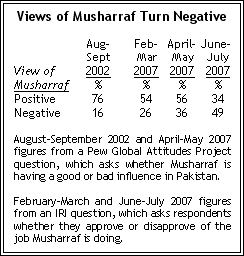
In the days following the Sept. 11, 2001 attacks, President Musharraf made dramatic shifts in Pakistan’s foreign policy, declaring his allegiance with the U.S. in the global war on terror and turning against the Taliban, which for many years had been supported by Pakistani intelligence services. Since then, the Bush Administration has stuck by Musharraf, overlooking his authoritarian tendencies in exchange for his cooperation in fighting al Qaeda. Within Pakistan, the general, who took power in a bloodless 1999 coup, largely remained popular. But there are signs that support for Musharraf is fading. In the Pew survey, conducted April 18-May 10, a 56% majority said Musharraf was having a positive impact on the country — down significantly from 2002, when 76% rated him positively.
More recent polling suggests that support for Musharraf may be declining rapidly. An International Republican Institute (IRI) poll conducted in February and March put Musharraf’s job approval at 54% — a level of support very close to what the Pew poll found two months later. However, a more recent IRI survey, conducted in June and July, finds his job approval sagging to 34%. Many observers have suggested that the controversy over Musharraf’s dismissal of Pakistani Supreme Court Chief Justice Iftikhar Chaudhry has badly damaged the president’s image (Chaudhry was recently reinstalled as Chief Justice). Others have suggested that the July 10 government raid on the Red Mosque has further weakened Musharraf. With parliamentary elections looming this fall, he is under intense pressure from liberals, who want democratic reforms and free elections, as well as from Islamists, who resent the military crackdown on extremists. And, as Obama’s comments and the NIE report highlight, he is under increasing pressure from his ally the United States, where ongoing concerns about terrorism and the heated atmosphere of a presidential campaign have brought renewed attention to the challenges Musharraf faces.


