As economically developing countries grow prosperous, their middle classes understandably become more satisfied with their lives. But many of their basic values also appear to change. Over time, the values of the middle classes in emerging countries become more like those of the publics of advanced nations. This is the overall conclusion of a new analysis by the Pew Research Center’s Pew Global Attitudes Project, conducted in partnership with the Economist magazine.1
The study finds that in 13 middle-income nations from regions around the globe, people tend to hold different opinions about democracy and social issues once they reach a certain level of wealth. Compared with poorer people in emerging countries, members of the middle class assign more importance to democratic institutions and individual liberties, consider religion less central to their lives, hold more liberal social values, and express more concern about the environment.
For decades, social scientists have argued that development leads to changes in public attitudes and societal values. This study suggests that on a variety of issues, the “global middle class” – people in emerging nations whose household income can be considered at least “middle income” by international standards – differs from poorer citizens.2
Democratic Values Especially Strong Among Middle Class
The analysis, which is based on the 2007 Pew Global Attitudes survey, finds further support for an old hypothesis: Economic well-being is linked with support for democracy. This does not mean that only the wealthy endorse democracy – on the contrary, support for democracy is solid in both rich and poor countries, and among both rich and poor respondents. However, it is especially strong among members of the global middle class.
For the last half century, social scientists have continually argued over whether economic development is linked to democracy. In the years following World War II, proponents of what came to be known as “modernization theory” contended that in societies throughout the world economic growth could lead to an embrace of democratic values and ultimately democratic governments.
In an influential 1959 article, the political sociologist Seymour Martin Lipset found that wealthier countries had a higher likelihood of sustaining democracy; writers, researchers, and policymakers have been debating his findings ever since. Many who have studied the work by Lipset and others have reached pessimistic conclusions about the prospects for democracy in developing nations.
[W]
Others are more optimistic. Larry Diamond, while acknowledging that economic growth helps democracies survive, has noted that “Over the past three decades, an unprecedented number of very poor countries have embraced democratic forms of government.” In The Democracy Advantage, Morton Halperin, Joseph Siegle, and Michael Weinstein make the case that much of the previous work on development and democratization has underestimated the resilience of democracy in lower-income countries.
Survey researchers working with data from the World Values Survey, the Afrobarometer, the Latinobarometer, the Latin American Public Opinion Project, and other sources have typically found broad international support – including support in poor nations – for many key features of democracy, such as individual rights and free and fair elections. Even though people in many nations do not enjoy the benefits of democracy, people nearly everywhere tend to express support and desire for democracy. Nobel Prize winning economist Amartya Sen says that democracy is now widely considered a “universal value,” writing that “While democracy is not yet universally practiced, nor indeed uniformly accepted, in the general climate of world opinion, democratic governance has now achieved the status of being taken to be generally right.”
The Pew Global Attitudes Project has consistently found widespread support for democracy across regions and countries, regardless of a nation’s wealth. Still, as this analysis shows, when compared with their poorer fellow citizens, members of the global middle class tend to express a somewhat more intense desire for democracy.
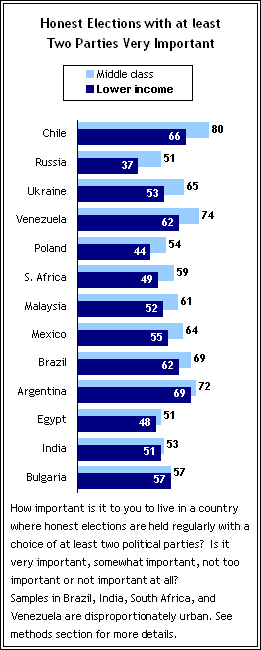
In the 13 nations included in this study, middle class respondents are often more likely to say it is very important to live in a country with key institutional features of democracy, such as fair multiparty elections and a fair judiciary. For example, in the 2007 poll eight-in-ten middle-class Chileans said living in a country with honest elections involving at least two political parties was very important to them, compared with about two-thirds (66%) of lower-income Chileans. In Hugo Chavez’s Venezuela, 74% of middle-class respondents said such elections are very important, compared with 62% among lower-income respondents, many of whom have formed the base of political support for Chavez throughout his controversial tenure.
The same pattern holds true in the former Soviet Union. Roughly half (51%) of middle-class Russians considered honest, competitive elections very important, while just 37% of those with lower incomes held this view. In Ukraine – where thousands took to the streets in 2004 to protest a national election widely seen as fraudulent – a 12-point gap separated the views of income groups on the importance of fair elections (middle class – 65% very important; lower income – 53%).
The global middle class is also more likely to emphasize the importance of the fundamental rights enshrined in the First Amendment to the United States Constitution: free speech, a free press, and freedom of religion. Among Indians, for example, 63% of middle class respondents said living in a country where you can say what you think and openly criticize the government is very important, compared with 52% of those with lower incomes.
On these questions about democracy, the gaps between the middle class and those with smaller incomes are not always large, but they are reasonably consistent – and sometimes they are quite pronounced. For instance, six-in-ten middle-class Poles rated a free press very important, compared with 42% of their lower-income compatriots. More than two-thirds (68%) among the South African middle class said a fair judicial system is very important, but only half (50%) of those with lower incomes agreed.

The middle class is also different when it comes to the role of freedom in their own lives. When asked to choose which is most important to them personally, free speech, freedom of religion, freedom from hunger and poverty, or freedom from crime and violence – essentially Franklin Roosevelt’s “four freedoms” – the global middle class was more likely than others to prioritize being able to speak freely in public. Lower-income respondents, on the other hand, were more likely to emphasize being free from hunger and poverty.
Many social scientists have observed that as societies grow increasingly wealthy, and as citizens’ basic needs are met, public values shift, with more importance attached over time to what University of Michigan political scientist Ronald Inglehart calls “self-expression” values, such as freedom of speech, tolerance, and trust.
In their 2005 book, Modernization, Cultural Change, and Democracy, Inglehart and Christian Welzel analyzed data from over 80 nations and elaborated a revised version of modernization theory that emphasizes the links among socioeconomic modernization, the development of self-expression values, and the growth of democracy. A society’s history and culture are important factors that can shape public attitudes, according to Inglehart and Welzel, but across cultures and traditions, the same general pattern holds true: as societies grow wealthier, their values shift, providing a more hospitable environment for democracy.
A Gap on Religion and Morality
While there is a gap between the global middle class and others on democracy issues, there is an even more consistent gap on issues tied to religion and morality. People in the global middle class are less likely to consider religion central to their own lives.

Previous Pew Global Attitudes research has shown a clear link between wealth and religiosity at the country level – as a country’s overall wealth increases, its level of religiosity generally declines. There are, however, some exceptions, most notably the United States, which is both wealthy and a religious nation.3 What this new analysis illustrates is that within countries, wealthier individuals are often less religious.
This pattern is true across a number of countries and a variety of faiths. One-third of the middle class in predominantly Catholic Mexico said religion is very important to them, while about half (48%) of poorer Mexicans express this opinion. Similar gaps exist in largely Hindu India (middle class – 60% very important; lower income – 72%). In Malaysia, which is majority Muslim but has significant Buddhist, Christian, and Hindu minorities, 60% of the middle class said religion is very important to them compared with 86% of those with lower incomes.
The global middle class is also less likely to believe faith is essential for morality. This pattern is especially strong in several of the predominantly Catholic nations in the analysis. Roughly six-in-ten (58%) middle-class Argentines, for example, said it is not necessary to believe in God to be moral and have good values, while just four-in-ten lower-income Argentines held this view. There are also double-digit gaps between the middle class and poorer respondents in the Latin American nations of Mexico and Venezuela, as well as in another largely Catholic nation, Poland.
Similar differences characterize views about homosexuality, especially in Eastern Europe. A clear majority (58%) of middle class Poles said homosexuality should be accepted by society, compared with just 41% of those with lower incomes. Half of middle-class Bulgarians believe it should be accepted, while only one-in-three (34%) expressed this view among lower-income respondents.
The Environment – a Middle Class Priority
There is a less pronounced, but still notable, difference between the global middle class and others on environmental issues. Middle-class respondents in many countries are more likely to consider global warming a very serious problem; and they are more likely to say that pollution is a very big problem for their country.
Among Ukrainians, for instance, 69% of those in the middle class say global warming is a very serious problem, compared with just 54% of lower-income Ukrainians. In India, Argentina, and Bulgaria – all countries where environmental concerns have surged in recent years – similar gaps are seen between middle class and less affluent respondents.
Life Satisfaction
Nearly everywhere, wealthy people tend to be more satisfied with their lives. Life satisfaction tends to be higher in wealthy countries; and in developing countries, it tends to be higher among wealthy people.4 So it is not too surprising that members of the global middle class tend to be more satisfied with their lives.

Still, the gap is often striking. When asked to place themselves on a “ladder of life,” where zero represents the worst possible life and 10 the best possible life, roughly half (49%) of the South African middle class rated their current life at least a seven, but only 24% of their poorer countrymen rated their lives as positively. Similarly, 52% of those in the Malaysian middle class placed themselves near the top rungs of the ladder (7-10), compared with just 30% of people earning less income.
Overall, across the 13 nations, the median percentage rating their current life in the range of seven to 10 is 50% among the global middle class and just 31% among poorer respondents.
When asked where their lives were five years ago, middle-class respondents again were more positive. Across the 13 nations, the median percentage of middle-class respondents saying their life five years ago rated at least a seven was 45%, compared with 33% of the less affluent. In some countries, the gaps were quite large – for instance, 73% of middle-class Mexicans said their lives five years earlier had rated a seven or higher, while just 57% felt this way among poorer respondents.
The middle class is also more likely to think their lives will warrant a high rating in the future. Overall, the 13-country median percentage among the middle class saying their lives would rate a 7-10 in the future was 71%; in contrast, 58% of less wealthy respondents felt this way. In Bulgaria, a 34-percentage-point gap was recorded on this question – 56% of those in the middle class said their lives would merit a 7-10 in five years, while only 22% of poorer Bulgarians said their lives would be near the top of the ladder.
Where the Income Gap is Largest
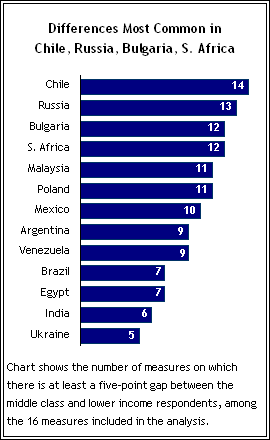
The survey found interesting differences between the global middle class and others in all of the 13 countries in this study, but these gaps were especially consistent in a few places. Notable differences were particularly common in Chile, Russia, Bulgaria, and South Africa. Looking at the 16 measures analyzed, on 14 of those middle class Chileans differed from lower income Chileans by at least five percentage points. Differences were only slightly less common in Russia (13), Bulgaria (12), and South Africa (12).
Considerably fewer differences were seen in Egypt (7), Brazil (7), India (6), and Ukraine (5) – four of the five poorest countries in the analysis.


