by Richard Wike, Associate Director, Pew Global Attitudes Project
With parliamentary elections approaching, Hungarians are in a funk. Nearly unanimously, they say the economy is in bad shape, and a stunning 72% say most Hungarians are actually worse off now economically than they were under communism. But Hungary’s malaise is not all about economics — most are frustrated with politics too. Overwhelmingly, Hungarians are dissatisfied with the way democracy is working and discontent with political elites, with about three-in-four saying political corruption is a major problem. A fall 2009 survey by the Pew Research Center’s Global Attitudes Project highlights the degree to which, even in a region where disillusionment is common, Hungarians stand out.
All of this bodes well for the electoral prospects of Fidesz, the right-of-center opposition party, which is expected to soundly defeat the incumbent social democrats in the upcoming elections.1 However, these findings do not mean Hungarians are rejecting democratic values. In fact, as the survey illustrates, they are more likely than other former Eastern bloc publics to say it is very important to live in a country with democratic rights and institutions. But few believe Hungary currently has these democratic freedoms.
Widespread Economic Discontent
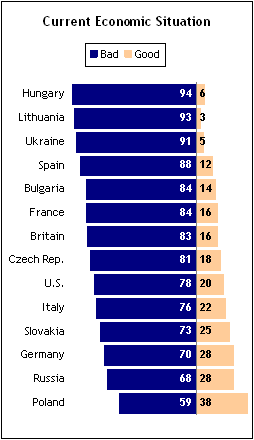
Prior to the revolutions of 1989, Hungary was an economic pioneer among Eastern bloc countries, practicing “goulash communism,” which mixed aspects of the free market with a planned economy. As a result, Hungarians enjoyed somewhat better living standards than their Iron Curtain neighbors. Two decades later, however, Hungarians give their economy dismal ratings, and they are generally less enthusiastic about the free market than others in the region.
The global economic crisis had a powerful effect across much of Central and Eastern Europe, and it hit especially hard in Hungary, which was forced to seek a financial bailout from the IMF, World Bank and European Union. The fall 2009 survey revealed the extent of Hungarian economic gloom: 94% described the country’s economy as bad, nosing out Lithuania (93%) and Ukraine (91%) for the most negative assessment among the countries included in the poll.
When asked to evaluate their nation’s switch to capitalism, Hungarians are divided — 46% said they approve of the move from a state-controlled economy to a market economy, while 42% disapproved. In 1991, when the Times Mirror Center (the forerunner of the Pew Research Center) asked this same question, 80% had approved of the change. In another sign that support for the free market is relatively weak in Hungary, only 31% in the 2009 poll agreed with the statement “Most people are better off in a free market economy, even though some people are rich and some are poor,” a lower percentage than in any other former Eastern bloc country surveyed.
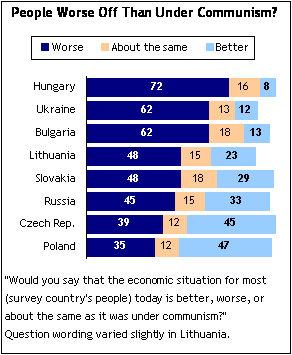
Remarkably, 72% said most people in Hungary are actually worse off today economically than they were under communism, while only 8% said most people are better off and 16% said things are about the same. Again, Hungary stands apart from the other post-communist societies surveyed — in no other country did so many believe that economic life is worse now than during the communist era.
As in much of the region, many Hungarians had hoped that accession to the European Union would result in major economic benefits and improved living standards. However, most have been disappointed. Roughly seven-in-ten (71%) say their country’s economy has been weakened by the economic integration of Europe. Bulgaria (63%) is the only other post-communist EU member in which a majority held this view.
Disillusionment With Politics Too
But Hungarians are not only disappointed with the economic transition their country has experienced — they are also disappointed with the transition to democratic politics. The 1991 Times Mirror poll found that 74% of Hungarians approved of the change from a one-party system to a multiparty system; by 2009 a slim 56%-majority expressed this view.
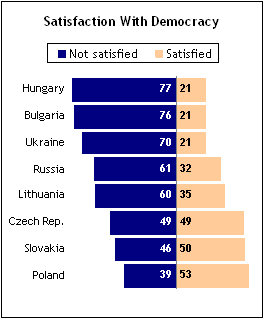
In the 2009 poll, more than three-in-four (77%) said they were dissatisfied with the way democracy is working in Hungary, the highest percentage on the survey. In the other former Eastern bloc nations, there were notable generation gaps on this question, with people under age 40 — essentially, the “post-communist” generation — more likely to be satisfied than older respondents. Not so, however, in Hungary, where old and young alike tended to give the current state of democracy a grim assessment.
As in much of Central and Eastern Europe, Hungarians are clearly disenchanted with political elites. Nearly nine-in-ten (89%) said politicians have benefited a great deal or a fair amount from the changes since 1989, but only 17% believed ordinary people have benefited. And concerns about corruption are common — 76% said corrupt political leaders are a very big problem in Hungary.
However, when reviewing these gloomy findings about the state of democracy in Hungary, it is worth remembering that they do not mean Hungarians are abandoning democratic values. To the contrary, Hungarians continue to want democratic rights and institutions — in fact, they place a higher premium on these things than their post-communist neighbors. When asked to rate the importance of six key features of democracy, Hungarians stand out for their strong embrace of democratic values.
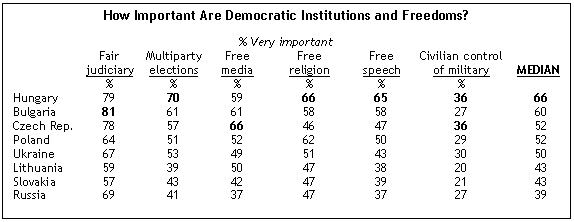
Among the eight Central and Eastern European publics surveyed, Hungarians are the most likely to say it is very important to live in a country with honest multiparty elections, freedom of religion, free speech, and civilian control of the military (tied with Czech Republic). Meanwhile, only Bulgarians are more likely to say it is very important to live in a country with a fair judiciary; and the Czech Republic and Bulgaria are the only countries more likely to rate a free media as very important. Overall, across the six values tested, a median of 66% in Hungary rated these features of democracy as very important. By this measure, Bulgaria is next, with a median of 60%, followed by the Czech Republic (52%), Poland (52%) and Ukraine (50%). Lithuania (43%) and Slovakia (43%) rate somewhat lower, while Russians (39%) are less likely than others to consider these elements of democracy very important.
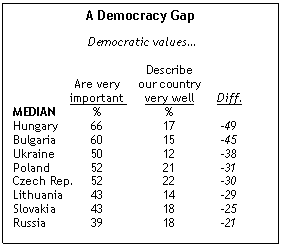
The challenge for Hungary is that, while most Hungarians want democratic values and institutions, few think they have them. For instance, 70% think it is very important to live in a country with honest multiparty elections, but only 17% believe this describes Hungary very well. Taking the median percentage saying these values are very important in each country and comparing it with the median percentage saying these values describe their country very well gives us an overall “democracy gap” for each country. The gap is large throughout Eastern Europe, but is widest in Hungary — evidence that Hungarians, who once pioneered the transition away from communism, are not turning their backs on democracy. Instead, they are frustrated by the fact that democracy has yet to fully flourish in their country.


