by Richard Wike, Associate Director, Pew Global Attitudes Project
Hungarian Prime Minister Ferenc Gyurcsany caused a stir at last weekend’s European Union summit in Brussels, warning his fellow leaders that they should not allow the current economic crisis to create “a new Iron Curtain” dividing the continent. Gyurcsany is hardly alone in thinking that the financial meltdown poses a serious challenge to European solidarity, and in particular, many observers are worried about the social and political stability of Eastern European nations, several of which have been hit especially hard by the crisis.
For instance, Forbes columnist and NYU professor Nouriel Roubini — widely lauded as one of the few people who saw the worldwide financial collapse coming — warns that the economic downturn may “even call into question the economic and political model Eastern European countries have followed since the 1990s.”
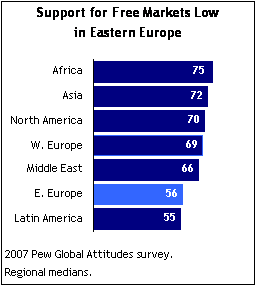
Survey research shows that in recent years support for the free-market system has been on the rise in Eastern Europe, especially in countries such as Poland that have enjoyed impressive economic growth. However, compared with other regions of the world — and in particular, compared with their Western European counterparts — Eastern Europeans embrace free markets somewhat tepidly.
A 47-nation 2007 Pew Global Attitudes survey found that, among the seven major world regions included in the study, support for free markets was lowest in Eastern Europe and Latin America. Across the six Eastern European countries surveyed — Bulgaria, Czech Republic, Poland, Russia, Slovakia and Ukraine — a median of 56% agreed with the statement “Most people are better off in a free market economy, even though some people are rich and some are poor.”
In contrast, a median of 69% of Western Europeans agreed. Support for free-market economics was highest in the world’s poorest region, Africa, where three-in-four said people are better off under capitalism, even if it does produce inequalities.
The poll revealed that support for the free market is especially strong among young people. Eastern Europeans who have spent most of their lives in a capitalist system are more likely to believe such a system is good for society, but support is markedly lower among older people in the region.
The survey also showed that beliefs about the free market are often tied to how people feel about their own lives — those whose lives were improving under capitalism were more likely to support it. This suggests the economic crisis could have some troubling implications for public opinion in the former Eastern Bloc: If the region’s economic situation continues to deteriorate, it could dramatically affect people’s sense of personal progress, and potentially weaken their enthusiasm for the capitalist system they have come to know over the last two decades.
Poles, Ukrainians More Supportive of Free Markets
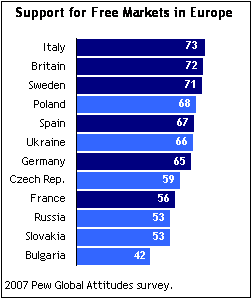
While support for free-market economics tends to be lower in Eastern Europe than in other parts of the globe, it is not uniformly low in the region. For example, in the 2007 survey, 68% of Poles endorsed free markets, up from 44% in 2002.
In 2007, roughly two-thirds (66%) backed free markets in Ukraine, a nation that has enjoyed rapid economic growth over the last few years. However, the Ukrainian economy has suffered severely in recent months, forcing the country to seek emergency funds from the IMF.
In the other four Eastern European countries surveyed, fewer than six-in-ten said most people are better off under capitalism. In Bulgaria, less than half (42%) held this view, although even this was a significant increase from 2002, when only 31% took this position. Meanwhile, France (56%) was the only Western European country surveyed in which fewer than six-in-ten said most people benefit from a free market system.
Capitalism Embraced by Younger Eastern Europeans
In five of the six Eastern European countries surveyed, support for free markets was strongest among young people. Having lived their entire adult lives in a post-communist era, people under age 35 were consistently more likely to agree that free markets are good, even if they produce inequalities. On the other hand, those age 55 and older, who were well into adulthood when the Berlin Wall fell, were generally the least likely to agree.
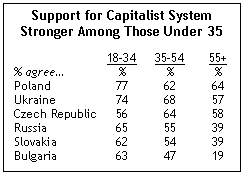
This pattern is clearest in Bulgaria, where 63% of 18-34 year-olds said people are better off under free markets, compared with 47% of 35-54 year-olds and just 19% of those 55 and older. Similarly, 62% of younger Slovakians back a capitalist system, compared with 54% of 35-54 year-olds and 39% of people 55 and over. The Czech Republic is the only country in the region where younger people are not more likely than others to endorse free markets.
Those Who Have Benefited Are More Supportive of Free Markets
In the four Eastern European nations where enthusiasm for free markets is lowest — Bulgaria, Czech Republic, Russia and Slovakia — support is also tied to perceptions of personal progress. Respondents to the survey were asked to rate both their current lives and their lives five years earlier on a 0-10 scale. People who rated their current lives higher than their lives five years before — those who had essentially “made progress” — were more supportive of free markets than were those whose quality of life had stayed the same or lost ground.

Once again, Bulgaria is the clearest example of this pattern. Among Bulgarians whose lives had improved, 60% agreed that people are better off in a free-market system, while 35% disagreed. Bulgarians whose lives had stayed the same were divided — 42% agreed and 43% disagreed. Among those who had lost ground, only about one-third (32%) agreed, while a majority (55%) disagreed.
Similar, although less pronounced, patterns were found in the Czech Republic, Russia and Slovakia. In Poland and Ukraine, the two countries in the region with the most enthusiasm for free markets, this pattern did not appear.


